Evaporative Air Cooler vs Traditional Air Conditioner‑Full Cost & Performance Comparison
When commercial and industrial buyers select cooling equipment, they usually compare evaporative air coolers and traditional refrigerated air conditioners. These two cooling solutions follow completely different working principles and fit distinct application scenarios. Clear comparison helps global importers, project contractors and factory owners make correct purchasing decisions.
Traditional air conditioners rely on compressors and refrigerant circulation to achieve cooling. They work well in fully enclosed rooms. However, obvious weaknesses restrict their application in large open or semi open sites. First of all, procurement and installation investment is high, including host units, pipeline systems and construction labor costs. Secondly, energy consumption remains very high during operation, bringing heavy monthly electricity expenses for large space users. Thirdly, AC systems recirculate indoor air without fresh air intake. In frequently opened factory workshops and shopping venues, cooling efficiency drops rapidly while indoor air becomes stuffy.
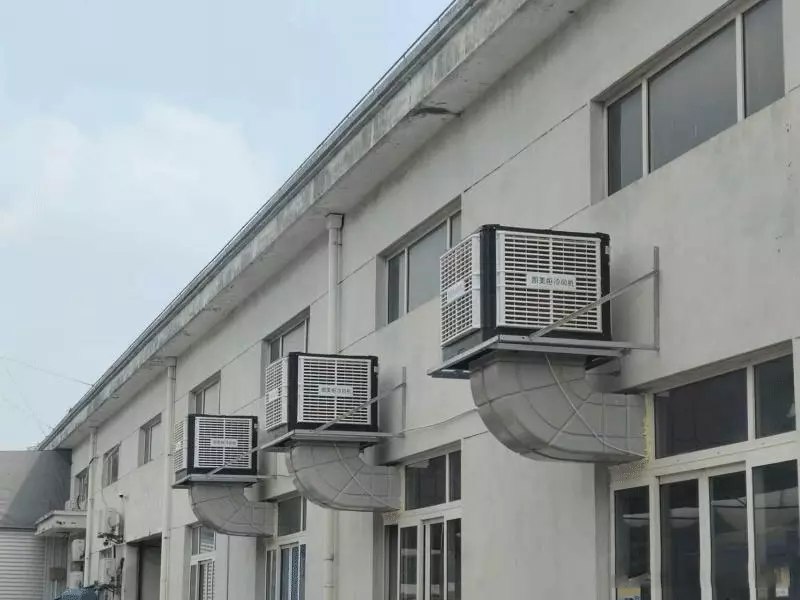
Evaporative air coolers work on water evaporation heat absorption without compressors or refrigerants. Their biggest strengths lie in low investment, ultra low power consumption and fresh air ventilation. The running electricity cost can be reduced by 70 80 % compared with conventional air conditioners. They perform excellently in open and semi open spaces where doors and windows are often opened. Even if gates keep opening for cargo transportation, cool fresh air can still fill the working area steadily.
It is necessary to understand the limitations objectively. Evaporative cooling performance is affected by ambient humidity. Cooling amplitude decreases in regions with persistently high humidity. Such environments can adopt hybrid solutions combining evaporative coolers and exhaust fans to strengthen ventilation. For totally closed high precision electronic workshops sensitive to moisture, evaporative units are not suggested as standalone cooling equipment.
From long term operation perspective, evaporative air coolers have simple mechanical structures and fewer wearing parts, so maintenance workload is much lower. Traditional AC needs regular maintenance for compressors and refrigeration circuits. As an experienced manufacturer, we suggest customers judge solutions based on space openness, local humidity, budget and air quality requirements. Many clients combine two systems: using evaporative coolers for large area basic ventilation cooling and installing small capacity air conditioners for individual precision rooms. This mixed mode achieves balance among cooling effect, energy saving and total cost control.
